The 2026 Guide To Blood Glucose Meters For People With Diabetes
Written by: Beyond Type 1 Editorial Team
8 minute read
November 13, 2026
Clinically reviewed by: Beyond Type 1 Clinical Team
Diabetes is kind of mean. If diabetes were personified and life were a “Mean Girls” movie, it’d be Regina George.
Diabetes can wreak havoc on your:
- Nerves
- Eyes
- Heart
- Blood vessels
- Kidneys
- Mental health
- Social health
- And more!
To spare your feelings, we won’t go on (because we could). This stresses the importance of keeping blood sugar levels stable—that means improving your time in range (TIR) and A1C. One way to do this is to use a blood glucose meter (BGM) full-time or as a backup to your continuous glucose monitor (CGM).
If you don’t like having a CGM attached to you at all times or aren’t ready to commit to one, a BGM can be a great option! In this guide, we explore some options you can check out in 2026 along with some key considerations.
How do blood glucose meters work?
BGMs are pretty user-friendly. You don’t have to be tech-forward to learn how to use one quickly.
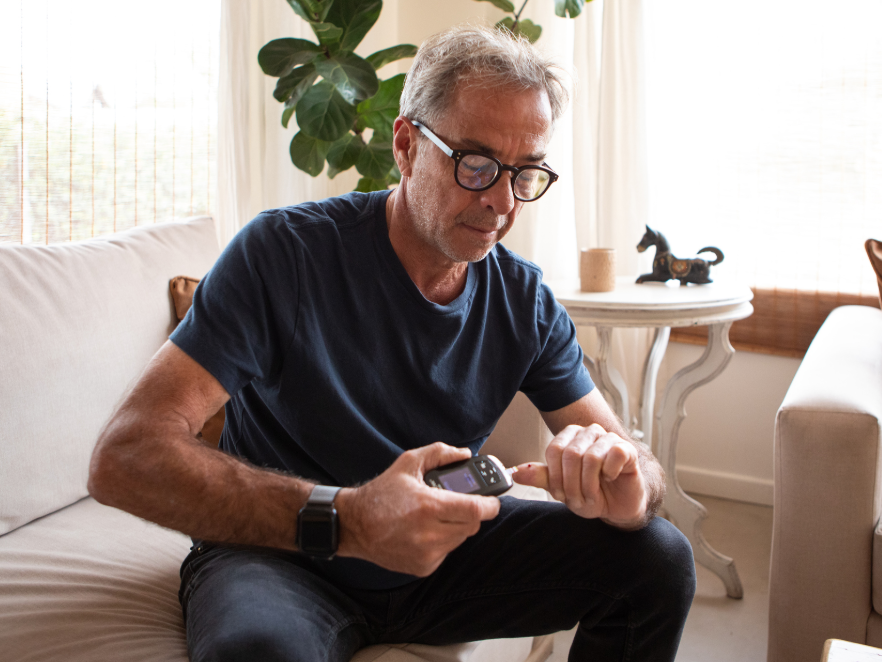
To use a BGM, most models follow these steps:
- Turn on your BGM.
- Prepare your test strip (what you stick into the meter).
- Sanitize your hands.
- Prick your finger with your lancing device and lancet (the needle inserted into the lancing device).
- Gently squeeze your finger until you get a healthy blood drop.
- Put your finger up to the test strip, and let the meter do its magic.
- You should get a reading you can act on within five seconds.
Federal requirements ensure a degree of accuracy with the levels shown by your BGM. As of 2026, Food and Drug Administration (FDA) standards, echoed by the American Diabetes Association (ADA), require meter results to be within 15% of actual blood sugar levels because that’s what they’d be read in a lab through your healthcare provider’s office.
28 BGM brands you can explore through the ADA
Since you don’t need a prescription to purchase a BGM anymore, the options you have can feel overwhelming, from where to look to what to look out for; you want to make sure your investment is the right one.
Here are some BGM brands the ADA lists that are worth exploring, either through a prescription that could be covered by your insurance or over-the-counter (OTC) at a place like Walmart or Walgreens:
- Accu-Chek
- CareSens
- Countour Next
- CVS Health
- Dario
- Diathrive
- Easygluco
- EasyMax
- Embrace
- Fora
- FortisCare
- FreeStyle—yes, the same people that make the CGMs!
- Glucocard
- iGlucose
- Infinity
- Jazz
- Nova Max
- One Drop
- OneTouch
- POGO
- Precision
- Presto
- Prodigy
- ReliOn
- Sinocare
- iHealth
- Telcare
- Trividia Health
That’s a lot of options, and honestly, there are even more out there! Just because they’re not on this list doesn’t necessarily mean they aren’t worth the investment. Talk to your healthcare provider (HCP) or pharmacist to see which option is best for you and what’s covered by your insurance or what the out-of-pocket cost is.
Sometimes, running it through your insurance won’t always give you the best price if your formulary prefers a brand name over a generic equivalent. Your pharmacist can explain that to you. You don’t need to know why right now. Just know it’s an option, and ask if your BGM costs more than you expect.
Pip Diabetes Care is also a popular brand for diabetes supplies, including BGMs, that you might’ve seen on social media. Genteel is also a great option if the thought of a lancing device freaks you out; it is also popular in social media circles. Do your homework, then ask your healthcare team questions. They can give you the best answer because they understand your current management and history.
Your HCP may even have some free samples to offer you at your next office visit—don’t be afraid to ask them about this!
Consider the cost of your BGM supplies, not just the meter
It’s not just the cost of your BGM that matters. You should also consider what the monthly cost will be for the supplies it needs to function, including:
- Lancing device (usually a one-time purchase)
- Lancets
- Alcohol swabs
- Tissue paper or bandages
Some brands cost more than others. Make sure you know what you’re getting into before you say yes!
Start by talking to your insurance company. Medicare pays for some diabetes supplies, but healthcare in Canada varies by province. Private insurance can help cover costs. For someone with type 1 diabetes (T1D), a health plan might cover part of the meter and most of the test strips. For people with type 2 diabetes (T2D), you may need a prior authorization (PA) from your HCP. They can help you with this!
Match your meter size with your lifestyle
Meters come in different sizes and shapes. If you want to test many times a day and are often on the move, you might prefer a small meter that fits in a bag, purse or glove box. Older people or those with trouble seeing might want to buy a bigger meter with larger buttons and a screen that’s easier to read or has a backlight. If you only test at home, you could get a meter that holds multiple strips. These don’t need a new strip each time you test, but they are usually big and cost more.
Are you calibrating your BGM each time you buy new test strips?
Some older meters require you to calibrate or code the meter when you start using a new batch of test strips. This may involve entering a code, scanning information with a smartphone or inserting a small chip into the meter. If the meter is coded incorrectly, your results may be inaccurate. Many newer meters are no-code or code automatically, which makes testing a lot easier. Look for this feature when choosing a meter!
Some meters come with control solution, while others require you to buy it separately. Control solution can be used to check that your meter and test strips are working properly. Follow the manufacturer’s instructions for when and how to use it.
Trust your body if something feels off and test again! Especially if you don’t have hypoglycemia (low blood sugar) unawareness.
BGM data can help you improve your diabetes management over time
A meter helps you see how your blood sugar changes over time, which can help you adjust your diabetes management plan alongside your HCP if needed. How much space you need in a meter depends on how often you check your blood and how often you or your HCP want to look at the data. If you check four times a day and your healthcare team wants to see a month of results, you need a meter that can store at least 120 tests.
Most high-quality meters hold at least 360 readings, and many let you add notes about eating or exercising when you test. You can get the data off the meter using a USB cable or Bluetooth. Some meters work with apps on your phone so you can track your results there.
Pro tips on using your BGM
In reality, pro tips are for people with diabetes (PWD) at any stage of life. When it comes to using a BGM like a pro, it simply means using it in ways that best support your body, lifestyle and overall diabetes management.
Here are three takeaways we want you to remember before you start using a BGM:
- Finding the best BGM means choosing the BGM that works best for you—no two people manage diabetes the same, so the right BGM for you might not be the right one for someone else. That’s okay!
- Choose the right test strips for your BGM. If you use test strips that don’t match, they might not give you accurate readings, even if they can be inserted into the BGM.
- Wash your hands before testing—always! Dirt, sugar or food debris can alter your results. Wash your hands with warm water and dry them before you draw blood from your fingertips. This also makes it way easier to draw the amount of blood you’ll need.
Everyone with diabetes benefits from testing, but it’s especially important for those with insulin-dependent diabetes (all people with T1D and some people with T2D) who need insulin at all times. Exercise, stress, medication and food all affect your blood sugar levels. A BGM is a helpful tool for managing your health and preventing future complications.
Navigating a new diabetes diagnosis can be scary, but you’re not alone! Download our Beyond Diagnosis guides, whether you need a refresher or are just starting. Diabetes isn’t easy for anyone, and while there’s no one-size-fits-all guidebook because it’s so personal, there are jumping-off points that benefit most PWD. Find them in this guide, then customize as you see fit with your healthcare team.

Author
Beyond Type 1 Editorial Team
Beyond Type 1 is the largest diabetes org online, funding advocacy, education and cure research. Find industry news, inspirational stories and practical help. Join the 1M+ strong community and discover what it means to #LiveBeyond a diabetes diagnosis.
Related Resources
The primary purpose of a medical ID is to speak for you when you cannot,...
Read more

Artificial sweeteners allow people with chronic conditions like type 2 diabetes (T2D) to indulge in...
Read more

On Friday, the Food and Drug Administration (FDA) cleared the tubeless Tandem Mobi. This makes...
Read more