Why Rural EMS Takes Longer To Arrive + What It Means For T1D Emergencies
Written by: Beyond Type 1 Editorial Team
5 minute read
September 9, 2026
When we think of a medical emergency, Hollywood paints a picture of someone calling 911, an ambulance gets sent, and within minutes emergency care is rendered, letting them live to see another day. Care and transport in an urban setting operates through the lens of speed and system density.
But in rural America, the response systems revolve around distance management and resource scarcity. The U.S. Census Bureau defines a rural area as a territory with less than 2,000 housing units or 5,000 people. This population takes up roughly 97% of our country’s landmass, housing around 20% of the population.
How long does it actually take for an ambulance to reach you in a rural area?
The biggest difference between a rural and urban (emergency medical services) EMS response is time.
A national study published in JAMA Surgery found that urban EMS response times averaged around seven minutes, whereas rural response times averaged more than 14 minutes. In nearly one in 10 rural encounters, response times approached half an hour.
Further studies showed that rural EMS not only had longer response times, but significantly longer on-scene and transport times as well. The most recent EMS data presented by the American College of Surgeons estimates that:
- Average total EMS call time is 74 minutes
- Rural EMS call times are 92.8 minutes
- High acuity (very emergent) call times averaged 97 minutes
- Rural trauma center transport times sometimes stretched to 155 minutes
When you’re managing symptoms of diabetic ketoacidosis (DKA), your CGM alarms “LOW,” or your insulin pump has failed and you live 30 miles out of town—you may be your own first responder until help arrives.
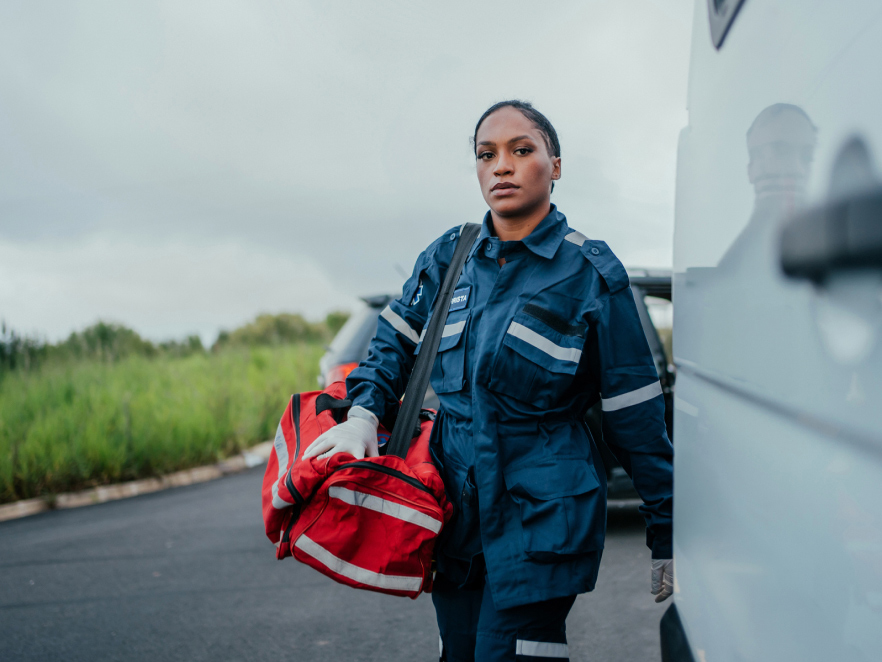
Why do rural EMS response times take so long?
The most obvious reason is distance. But there are reasons more nuanced than that.
In cities, ambulances are closely distributed because population density calls for it. But in rural counties, the only ambulance may already be transporting another patient, returning from the hospital that’s 45 minutes away or not able to transport patients at all.
In fact, a lot of rural EMS services are closely affiliated with services in the neighboring county, calling upon one another to help support calls when they are unavailable.
The CDC also reports that it’s common for rural EMS systems to rely on:
- Volunteer staff
- Part-time responders
- Lower-certification crews
- Fee-for-service funding models that bill for the emergency services provided
This creates the tough reality that sometimes ambulances exist, and sometimes there is no one to staff them. And even when they do have someone to staff the ambulance and run calls they may only be operating at a Basic Life Support (BLS) level, which means that the crew may not have access to the same medications, procedures or advanced interventions available to paramedic-level providers (ALS).
- And even if a rural ambulance does arrive, there exists other barriers to receiving lifesaving treatment and care. For one, financial instability is putting rural hospitals at risk of closing altogether.
This leads to significant delays for emergencies that require intensive care unit (ICU) admission, endocrinology support, pediatric support, DKA stabilization or advanced airway management. The extra 45-minute (or longer) transport to the hospital means your symptoms can worsen with delayed treatment and increase your risk for ICU admission.
What can you do to prepare for a rural diabetes emergency
Find out what your local EMS designation is.
- You can do this by checking your state’s Office of EMS website. Most states publish this information by county.
- Call your local ambulance service’s non-emergency line and ask directly if they’re BLS or ALS.
- Check your county or city government website. Some list their EMS or fire department’s certification level under public safety information.
- Ask your healthcare provider. They often know the certification level of the services they work with regularly.
Save important phone numbers. This can be your local ambulance’s non-emergency lines, the nearest ALS-capable hospital, after-hours healthcare provider lines, etc. Have them easily accessible.
Work with your healthcare team to come up with a rural-specific, sick day plan. Ask which symptoms warrant an earlier-than-usual call to 911, given your response time. Expert tip: A lesser known perk of living in a rural area is that you may be able to contact your local ambulance to give them a heads up on your medical history. A lot of services have administrative staff that can take note of this which can clear the way for faster and easier access to care.
Build backup supplies into your routine. Keep backup insulin, extra pump supplies, ketone strips, glucose tablets and glucagon on hand. Make it a habit to check expiration dates regularly.
Have documentation of your medical history easy-to-see and readily accessible. When responders do arrive, they quickly can gain crucial information to start care and treatment faster.
The bottom line
Understanding why rural EMS response times can be long and unpredictable helps put you in control of what you can prepare for. One of the best ways to deal with slow response times is to have a plan already in place.
Now you have the tools and information to set yourself up for success, but what about the person down the road who knows none of this yet?
Beyond Ambassadors exists for exactly this reason—to spark change, turn personal experience into collective power, and make sure no one in your community faces a diabetes emergency unprepared.



Author
Beyond Type 1 Editorial Team
Beyond Type 1 is the largest diabetes org online, funding advocacy, education and cure research. Find industry news, inspirational stories and practical help. Join the 1M+ strong community and discover what it means to #LiveBeyond a diabetes diagnosis.
Related Resources

Sex is a unique form of physical exercise that most of us look forward to....
Read more

So you got the lab results, saw the word “prediabetes” and now there’s one question...
Read more

When you were told you have type 2 diabetes (T2D), you probably learned you need...
Read more