How to Talk to Your Child About CGM Data Without Talking About Their Body
Written by: Christine Fallabel
7 minute read
August 18, 2026
Last month, the Food and Drug Administration (FDA) approved the first over-the-counter continuous glucose monitor (CGM) for children who do not use insulin. This approval is for children under 18 years old who do not have diabetes and for those who have type 2 diabetes (T2D) who use oral medications to manage their blood glucose levels.
Roughly one in five children in the United States lives with obesity (a main risk factor for T2D), and rates of both prediabetes and type 2 diabetes are on the rise in this age group.
Access to over-the-counter CGMs, without a prescription, can play a key role in developing glycemic awareness for children and their families by providing real-time blood glucose data before, during and especially after meals and exercise.
This is a major win for access for both children living with T2D and those looking to prevent diabetes. However, there may be serious repercussions, especially in such a young, vulnerable population—and healthcare providers, caretakers and parents should be aware of these before giving kids a CGM.
A few things to consider include:
- What happens when children grow up seeing their glucose data on a screen?
- How do parents help kids understand their bodies without teaching them to fear certain foods?
- What can adults do to help children avoid chasing “perfect” numbers?
- How can adults help children avoid reducing their health to a single data point?
The answer starts with remembering one simple truth: glucose is information, not a final grade.
What does healthy CGM monitoring look like?
One of the most important lessons that parents and guardians can teach children is that bodies are not machines designed to produce the same exact number every second of every day: we are constantly recalibrating, and that’s a good thing!
Blood glucose naturally rises and falls. It changes after eating, during exercise, when we are stressed, when we’re sick, when we sleep and even during normal growth and development, whether or not you live with diabetes.
A glucose “spike” is not automatically a problem. A child eating a birthday cupcake, having pizza with friends or enjoying a family holiday meal is not a health failure. Food is more than fuel. It represents culture, connection, celebration, comfort and joy.
The concern is that without context, children may begin to interpret normal glucose fluctuations as something they need to control or fix.
While monitoring blood glucose data can be helpful and preventing type 2 diabetes with the use of technology can be revolutionary, placing a micro-focus on everything a child eats and experiences in a day can be a recipe for mental health challenges down the road, unless boundaries are put in place.
If your child has been diagnosed with prediabetes or you are wanting your child to wear a CGM to more closely monitor blood glucose levels, talk with your doctor first to see if it’s recommended.
If you get the green light, reinforce boundaries such as:
- Having the parent or guardian “follow” their child’s CGM data, so the onus on checking blood glucose levels is not on the child
- Not checking the blood glucose levels immediately after eating meals (a spike is normal for most everyone!). The usual rule-of-thumb is waiting two hours after eating to see how your blood glucose has responded.
- Not banning certain foods or restricting meal times or portions based on CGM data alone.
- Not labeling foods “good” or “bad”
- Do not force exercise to “bring down a bad blood glucose level”
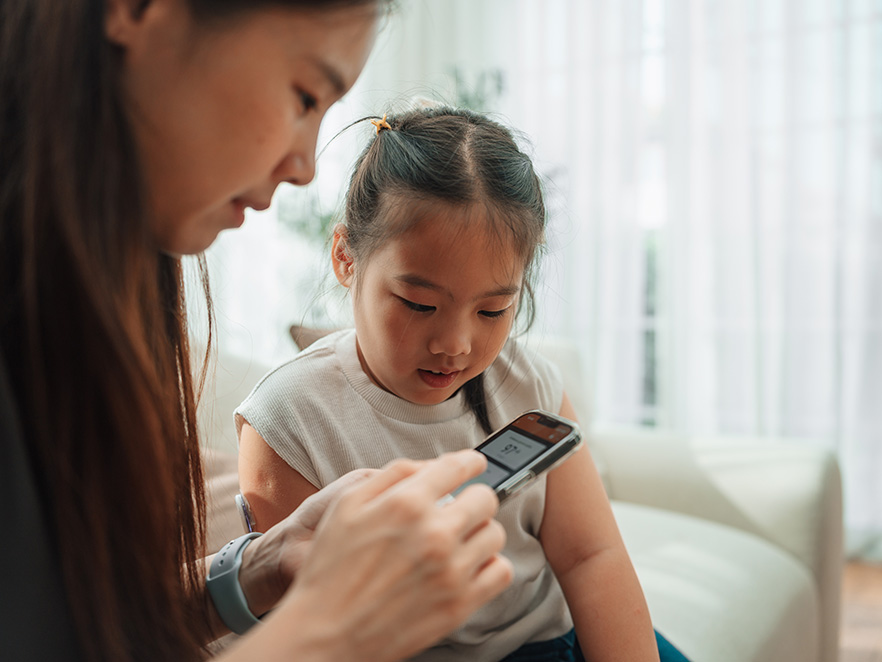
Avoid making their CGM the “food police”
Sometimes completely normal blood glucose swings can lead to unnecessary dietary changes. A child or teenager might see their glucose rise after eating a banana and think, “Bananas are bad.” They might notice a higher number after a bowl of cereal and believe, “I shouldn’t eat that anymore.”
Even without anyone’s influence, they may start categorizing foods as “good” or “bad” instead of understanding that all foods can have a place in a balanced life. This can start with making the CGM a food police device, paired with excessively checking blood glucose after meals and categorizing foods as either “allowable” or “forbidden,” which can have lasting effects on a child’s mental and emotional health.
Some tips to avoid making CGMs turn into “food police” include:
- Don’t make the CGM a constant monitor of whether a child “made the right choice” at mealtime
- Emphasize balance in all foods
- Focus on curiosity, not judgment
And a few swaps in what you say can make a meaningful difference:
When you want to say: Wow, that food made your glucose go really high.
What to say instead: Isn’t it interesting how our bodies respond differently to different things?
When you want to say: You shouldn’t eat that because it spikes your sugar.
What to say instead: Food gives our bodies energy. Different foods affect our bodies in different ways, and that’s normal.
Talk about patterns, not perfection
Over time, CGM data can shape a child’s relationship with food and their body as well. Think in terms of blood glucose patterns, instead of aiming for perfection with every food choice and every meal.
Most children do not need to know what every blood glucose number symbolizes, especially if they’re not living with diabetes.
Parents and caretakers can encourage healthy conversations by asking questions like:
- What did you notice when you ate that?
- How did your body feel during that activity?
- What patterns do we see over time?
- What helps you feel strong and happy?
- What foods give you energy?
- What foods make you sleepy?
Model a healthy relationship with technology
Remember that as a parent or caretaker, your child’s relationship with technology starts with you. Children and teenagers see everything we do, and they often learn how to interact with technology by watching the adults around them.
If you’re constantly checking your own devices, panicking over their numbers or are always talking about needing to “fix” your body, children will absorb those messages.
The good news? It works both ways. Families can model healthy boundaries:
- Checking data at appropriate times rather than constantly
- Taking breaks from screens
- Discussing information without fear but rather with curiosity
- Remembering that numbers are only one small piece of overall health
Technology should support life, not become the center of it.
Remembering the bigger picture of health
If your goal with an over-the-counter CGM for your child or teen is weight control, blood glucose management or even diabetes prevention, it is important to remember that a CGM device will only deliver on one data point: blood glucose numbers. A healthy life is made up of many contributing factors.
A healthy child is also a child who feels comfortable eating a variety of foods, moving their body in ways they enjoy, sleeping well, maintaining close friendships, laughing, learning and feeling confident in who they are.
For families affected by diabetes, CGMs have provided life-changing support and safety. For families using CGM technology outside of traditional diabetes care, there is an opportunity to approach these devices with thoughtfulness and care.
The most powerful lesson parents can teach is not how to achieve a perfect glucose graph. It is to balance the data to better inform choices that can help us understand our bodies.
We can do this without vilifying food, obsessing over every number or creating unnecessary stress in our children and teens.
Looking for more on diabetes technology and equipment? Check out our resources here!



Author
Christine Fallabel
Related Resources

Sensitive Topic Warning: This article discusses anxiety, stress, depression and mood swings, which may be...
Read more

First responders bring to mind 911 emergencies where paramedics respond to provide lifesaving care. But...
Read more

If you live with diabetes and take insulin, you've probably heard of diabetic ketoacidosis (DKA),...
Read more