How Does DKA Impact Your Body + How Can You Prevent It?
Written by: Ginger Vieira
11 minute read
October 1, 2026
Medically reviewed by: Joanne Rinker MS, RDN, LDN, BC-ADM, CDCES, FADCES
If you live with diabetes and take insulin, you’ve probably heard of diabetic ketoacidosis (DKA), whether it happened to you at diagnosis or later on. DKA is a serious, life-threatening complication that can affect people with type 1 diabetes (T1D) and type 2 diabetes (T2D).
But do you know what actually happens to your brain and body during DKA?
At past American Diabetes Association (ADA) Scientific Sessions, which bring together diabetes industry scientists, leaders, researchers and community members to understand the latest findings in diabetes research, advancements in care and the year’s standards, several experts broke down the science behind DKA.
In this guide, we explore their findings to help you understand exactly what happens to your brain and body during DKA. And what you can do to prevent it from happening to you or someone you love down the line!
What causes DKA and how does it feel?
First, let’s break down why DKA happens in the first place and how it feels and presents. DKA happens when your body doesn’t have enough insulin to let glucose (sugar) into your cells for energy. DKA doesn’t happen because of high blood sugar. That’s a misconception! High blood sugar is actually a warning sign you’re insulin-deprived. Your blood glucose can actually be normal and DKA can be present. In either case, high or in-range glucose, DKA happens when you don’t have enough insulin in your body.
Without enough insulin, your cells start breaking down fat for fuel instead of glucose, which produces ketones. When ketones build up too fast, your blood becomes acidic, which is what makes DKA so dangerous.
DKA symptoms can include:
- Excessive thirst and frequent urination
- Nausea and vomiting
- Abdominal pain
- Fruity-smelling breath
- Rapid or deep breathing
- Fatigue or weakness
- Confusion
If left untreated, severe DKA symptoms can include:
- Loss of consciousness
- Coma
- Seizures
- Multiple organ failure
- Premature death
Why does DKA happen?
DKA happens for a variety of reasons. Remember, it’s simply because you’re insulin-deprived, but what causes that deprivation varies.
Some of the most common situations that lead to DKA include:
- You’re newly diagnosed with T1D or T2D and haven’t started insulin yet.
- You missed insulin doses or your insulin pump malfunctioned.
- You’re managing an illness, infection or other physical stress that raises your insulin needs.
- Your blood sugar has been elevated for an extended period without correction.
Experts at the ADA Scientific Sessions shared that DKA is now considered more common in children with T1D and adults with T2D at the time of diagnosis. Sadly, it is the leading cause of death in children with T1D. Misdiagnoses, where someone is diagnosed with T2D but is actually living with T1D, have also been shown to lead to a higher risk of DKA. This risk for misdiagnosis is why it’s so important for antibody tests to be included at diagnosis.
What happens to your brain during DKA?
What happens to your brain during DKA is quite interesting. It’s amazing how much the body goes through! ADA presenter, Fergus Cameron, M.D., explained that the circumstances occurring shortly before or after a diabetes diagnosis can create predispositions for neural (brain) injury.
At the ADA Scientific Sessions, Cameron broke down findings from several studies, including:
Overall, the studies showed that chronically high blood sugar lasting weeks or months, along with worsening DKA, causes the most harm to the brain. This happens most often both before diagnosis and in the days or weeks right after.
Why does DKA affect brain development?
Researchers studied several areas of cognitive (mental) function, including full-scale IQ, executive function, information-processing speed, working memory and general memory.
Across their findings, data showed:
- Whether or not a child or adult was in DKA at the time of diagnosis plays a huge role in overall brain injury from T1D.
- Children diagnosed before age five, presenting with DKA at diagnosis, showed the strongest evidence of brain injury.
- Children diagnosed after age 10, without DKA at diagnosis, showed the lowest evidence of brain injury.
- Children with A1C levels over 8% performed more poorly compared to IQ norms of same-aged peers without diabetes.
- Adults diagnosed with T1D during childhood have substantially increased evidence of cognitive impairment later in life.
Remember, this injury stems from the combination of prolonged high blood sugar and the acidic strain DKA puts on the body, particularly the brain.

How does DKA at diagnosis affect long-term brain health?
Over an extended period of time, DKA and chronically high blood sugar levels can contribute to other issues for PWD.
These include:
- Chronic inflammation and oxidative brain damage: chronically high blood sugar levels cause more injury to the brain than previously thought, according to researchers.
- Increased dementia risk: the number of cases of both dementia and T2D were expected to at least double, and potentially triple, over the next 30 years, explained Anna Marseglia, Ph.D. Diabetes is a clearly established risk factor for the development of dementia.
- Reduced cognitive (mental) performance: severe high blood sugar levels experienced in early childhood are also associated with poorer cognitive performance. However, research suggests mild-to-moderate lows do not damage the brain as significantly as once thought.
The evidence of brain injury resulting from DKA, A1C levels over 8%, and severe hypoglycemic events is strongest in those who were diagnosed earliest in life.
Can you reduce your risk of dementia with diabetes if you had DKA?
While reducing dementia risk as a person with T2D can be managed largely by improving overall blood sugar levels, Marseglia’s research points to another major factor: living an active life.
The study, Participating in Mental, Social and Physical Leisure Activities and Having a Rich Social Network Reduce the Incidence of Diabetes-Related Dementia, found that PWD who had lower levels of overall activity and a poor social network had a significantly higher risk of developing dementia than those with moderate-to-high levels of leisure activity or a rich social network.
How can you help reduce the risk of DKA for others?
Reducing the risk of DKA at diagnosis, regardless of age, culture, lifestyle or the form of diabetes you present with, starts with awareness of the signs of diabetes. If you are aware of the signs, you can screen and diagnose diabetes earlier, before it progresses to a dangerous state that sometimes causes irreversible damage.
The four most common signs of diabetes include:
- Frequent urination
- Unexplained weight loss
- Excessive thirst
- Exhaustion
T1D screening options
Early screening and detection can be even more helpful! They are a step you take before symptoms even present.
Screening and detection must happen before signs present, because if you’re already experiencing symptoms, it’s too late to screen and you must see a doctor ASAP. Since 85 to 90% of people diagnosed with T1D have no family history, there’s never been a better time to screen since options have expanded.
Today, there are even needle-free options available to help you start the screening process, making the experience a little friendlier and more comfortable for those who fear needles.
Current T1D screening options include:
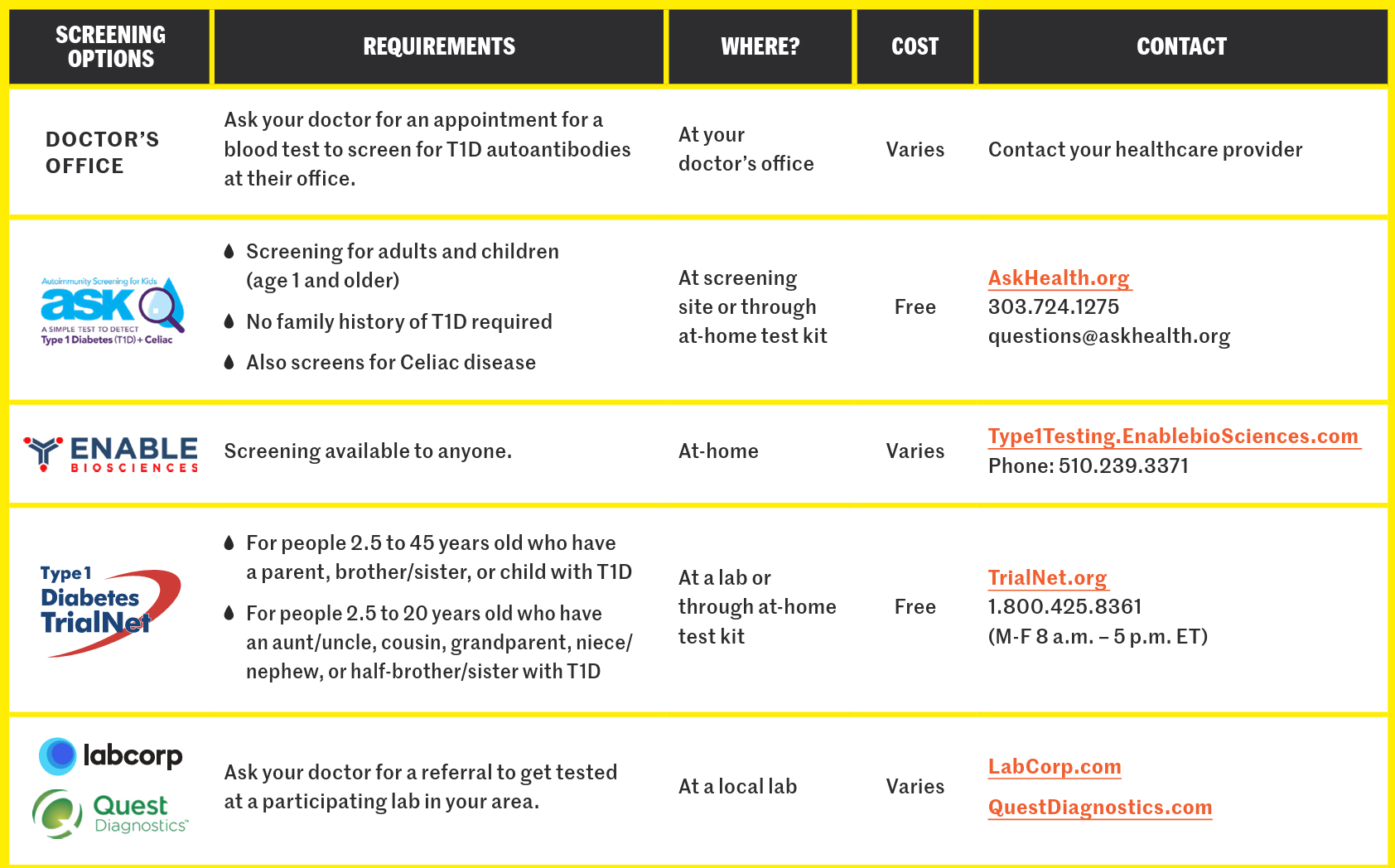
- ASK Program: offers free autoantibody testing for T1D and celiac disease in the U.S.
- Enable Biosciences: offers T1D screening through a basic fingerstick.
- TrialNet Pathway to Prevention: provides FREE autoantibody testing to first-degree relatives between the ages of 2 and 45, second or third-degree relatives between the ages of 2 and 20 and individuals aged 2 to 45 with a positive T1D autoantibody test outside of TrialNet.
- Labcorp or Quest Diagnostics: tests from both places use the T1D Autoantibody Panel (testing for GAD65, ZnT8, IA-2 and IAA) to help you identify early risk of T1D before symptoms begin.
- T1D Scout: assesses your genetic risk of T1D using just a saliva swab from the comfort of home.
Explore which may be right for you here.
T2D screening options
T2D screening is important for diagnosis. If you have any symptoms and suspect you have it, get screened. T2D can lead to severe complications over time or even premature death—early screening can help identify it before it progresses to DKA or causes other complications.
Current T2D screening options include:
- A1C test: this measures your average blood sugar over the past two to three months.
- Fasting plasma glucose test: this analyzes your blood sugar levels after you haven’t eaten for at least eight hours.
- Oral glucose tolerance test: this measures your blood sugar before and after drinking a sugary liquid.
- Random plasma glucose test: this analyzes your blood sugar at any time, regardless of when you last ate.
- Risk assessment screenings: such as those offered through the CDC’s Prediabetes Risk Test, which can help determine if further testing is needed
Screening for prediabetes can be a valuable first step in getting an accurate and timely T2D diagnosis, giving you the best possibility of preventing DKA. Talk to your doctor about which screening option is right for you, especially if you have risk factors like a family history of diabetes, high blood pressure or being over age 45.
The future of detecting DKA before it starts
Thankfully, technology, medication, support and education for PWD continue to improve, which also supports better long-term health outcomes for community members. The findings reported in this article on the potential damage caused by DKA at diagnosis highlight the value of evolving tools such as teplizumab (Tzield), which delays the onset of T1D in those who qualify, and breakthrough screening options.
While the thought of having diabetes can be scary, what’s even scarier is not knowing you have it. Getting proactive can help protect your long-term health and, in some cases, even save your life!
This educational resource is made possible through the support of Abbott Diabetes Care. Beyond Type 1 retains complete, independent editorial control over all content.
If you would like to become a Beyond Type 1 ambassador to help others recognize the signs of diabetes earlier, join here. Spread the word in your community!



Author
Ginger Vieira
Related Resources

Eat your vegetables and protein first, and save your carbs for last. That's the idea...
Read more

Sequel, the insulin pump manufacturer of the twiist insulin pump, announced on Friday, October 16,...
Read more

This article references in-kind partners supporting the Beyond Type Run team on race day. The...
Read more