Who’s High Risk for Type 1 Diabetes?
Written by: Julia Flaherty
7 minute read
July 17, 2026
According to the T1D Index, 9.5 million people around the world are living with type 1 diabetes (T1D). In the United States (U.S.), the Centers for Disease Control and Prevention (CDC) estimates that 2.1 million people live with T1D—1.8 million adults over the age of 20 and 314,000 children under the age of 20.
The CDC also states that 27.6% of Americans are living with undiagnosed diabetes, which encompasses all forms. This means you or someone you care about could be at risk of developing a form of diabetes later in life.
Recognizing the signs and understanding your risk is critical so that, if you notice any changes in your body, you can act quickly. In this guide, we identify who is most at risk of developing T1D specifically so that you can stay informed and proactive about your and your loved ones’ health.
Genetic risk of developing T1D
T1D occurs when your body’s immune system attacks its own beta cells in the pancreatic islets, leading to a loss of insulin production. This is why T1D is classified as an autoimmune disease, because it results from an autoimmune reaction. While researchers remain unclear about the exact root cause of T1D, many believe genetic or environmental factors trigger it. Lifestyle factors do not cause T1D (nor do they always cause type 2 diabetes).
Genetic risk factors vary depending on your level of familial relationship, such as whether a parent has T1D versus a cousin or even a more distant relative. The American Diabetes Association (ADA) has shared compelling data on the associated risk.
Siblings of people with T1D may be at high risk
If you have a sibling with T1D, you may be at a greater risk of developing it in your lifetime.
Studies have shown:
- The risk of siblings of people with T1D developing it ranges from 1:35 to 1:12 (3% to 8%).
- The risk is higher for siblings of people with T1D if the sibling developed T1D before age 7.
- The risk of developing T1D is higher for monozygotic (identical) twins—1:3 to 1:2 (33% to 50%).
- By age 60, it’s estimated that 10% of first-degree relatives of people with T1D will develop it themselves.

Children of parents with T1D may be at a higher risk
Breakthrough T1D concurs that first-degree relatives have the highest risk of developing T1D over their lifetimes. This means that if you have a parent, sibling or child with T1D, you should make sure you’re aware of the signs. Breakthrough T1D notes that being a first-degree relative increases your risk of developing it 15-fold.
Children of parents with T1D may be at the highest risk of developing T1D within their lifetimes.
If you are a parent living with T1D, here’s what you should know about your child(ren)’s risk of developing it:
- If you’re an adult male with T1D, the odds of your child developing it are 1 in 17.
- If you are an adult woman with T1D, the odds of your child developing it are 1 in 25 if you gave birth before age 25.
- If you are an adult woman with T1D, the odds of your child developing it are 1 in 100 if you gave birth after age 25.
- If either parent developed T1D before age 11, the child’s risk of developing it doubles.
- If both parents have T1D, the risk is between 1 in 10 and 1 in 4.
- If you have T1D and type 2 polyglandular autoimmune syndrome, your child’s risk of developing T1D is 1 in 2.
- If you and your child are white and share the HLA-DR3 or HLA-DR4 genes, your child’s risk is also higher.
- The HLA-DR7 gene may also increase the risk in African Americans, while the HLA-DR9 gene may increase the risk in Japanese people.
Risk estimates continue to improve as researchers learn more about T1D. And just because the risk of your child developing T1D is high if you’re a parent living with it, it isn’t a reason alone to avoid parenthood if you feel compelled to. Many people with T1D can offer their children rich, fulfilling lives and have healthy pregnancies despite the disease’s obstacles.
Modern medication and technology have never been better, and the outlook appears to keep improving.
Screening helps T1D parents understand their children’s risk
One of the best ways to truly know and understand your child’s risk is to have them screened regularly. Screening for T1D means testing for autoantibodies. Autoantibodies are produced when the immune system is attacking the insulin producing beta cells. This can happen years before a T1D diagnosis- thus why we use it as the screening test for T1D.
Screening options vary. You can explore which may be right for you.
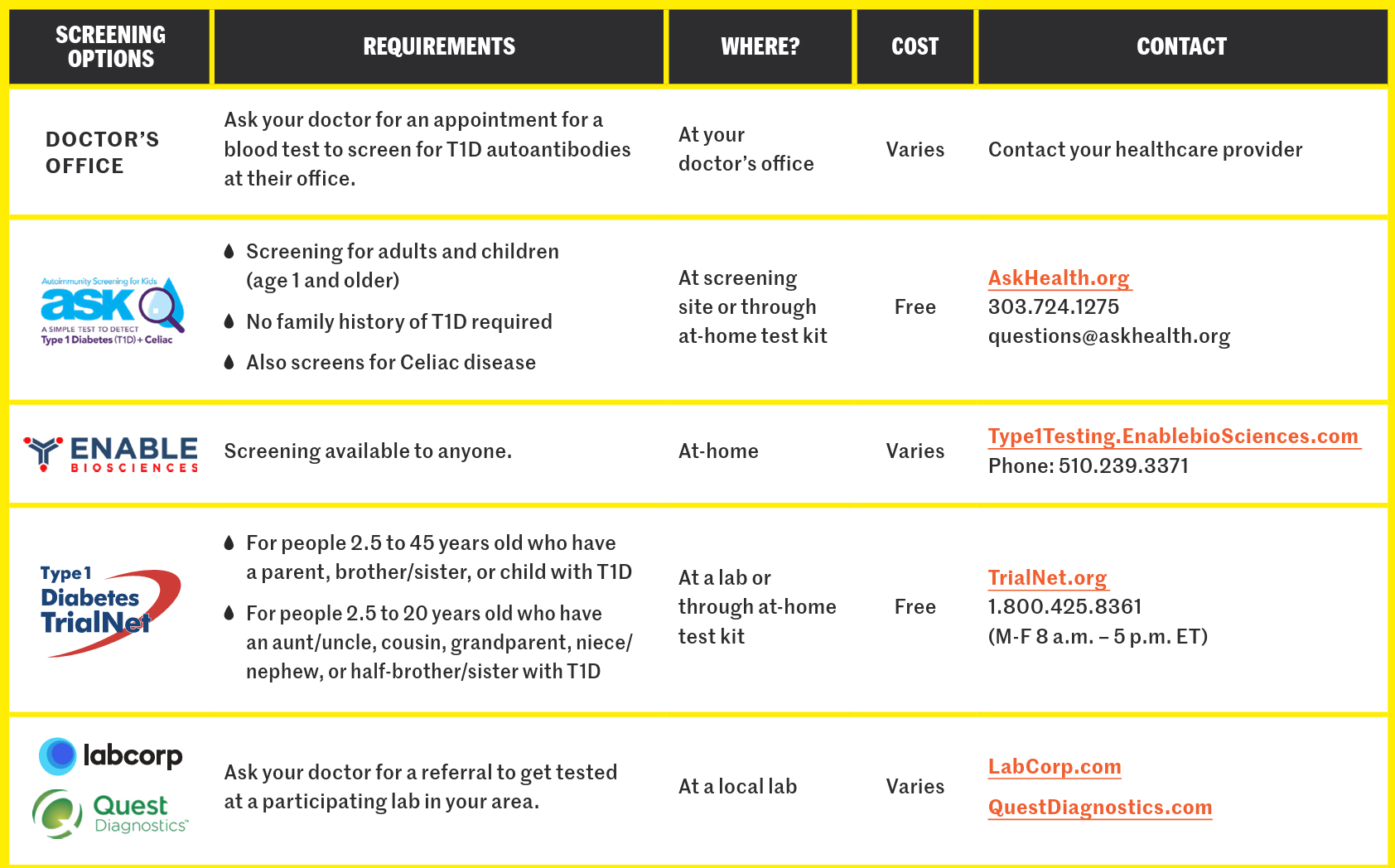
- ASK Program: Offers free autoantibody testing for T1D and celiac disease to U.S.
- Enable Biosciences: Offers T1D and screening through a basic fingerstick.
- TrialNet Pathway to Prevention: Provides FREE autoantibody testing to first-degree relatives between the ages of 2 and 45, second or third-degree relatives between the ages of 2 and 20 and individuals aged 2 to 45 with a positive T1D autoantibody test outside of TrialNet.
- Labcorp or Quest Diagnostics: Tests from both of these places use the T1D Autoantibody Panel (testing for GAD65, ZnT8, IA-2 and IAA) to help you identify early risk of T1D before symptoms begin.
- T1D Scout: This program assesses your genetic risk of T1D using a saliva swab, making it friendlier and more comfortable for children.
Knowing your child’s risk may feel scary, but it also means you can take action. If your child tests positive for antibodies associated with T1D, they may be eligible for clinical trials or drug therapies that delay T1D or seek to cure it, like Tzield which helps delay T1D in children as young as two years old.
If your healthcare provider isn’t familiar with how to order a T1D screening
Just show this list to your HCP for T1D autoantibody screening:
Labs to Order
- Insulin Autoantibody (IAA)—CPT 86337
- Glutamic Acid Decarboxylase (GAD) Autoantibody—CPT 86341
- Islet Antigen 2 (IA-2) Autoantibody—CPT 86341
- Zinc Transporter 8 (ZnT8) Autoantibody—CPT 86341
Diagnosis Codes
- Z83.3 Family history of diabetes
- R73.9 Hyperglycemia, unspecified
- Z13.1 Screening for diabetes mellitus
What if you have no family history of T1D?
Having no family history of T1D doesn’t make you immune to it—T1D cannot be contracted like the cold or flu. In fact, up to 90% of new T1D cases report having no family history.
What should I do if I believe that I am living with T1D?
Recognizing the signs early can make all the difference. Here’s what to watch for and what to do next.
Symptoms of T1D usually include one or a combination of the following:
- Excessive thirst
- Frequent urination or bedwetting
- Blurry vision
- Slow-healing cuts or wounds
- Unexplained weight loss
- Intense hunger
- Irritability or mood swings
- Exhaustion or fatigue
If you or your loved one believes they are living with T1D, seek immediate medical care. T1D should be treated urgently once symptoms develop.
The longer symptoms are ignored, the more your life can be put in danger. The risk of diabetic ketoacidosis (DKA) grows the longer a diagnosis or treatment is delayed. Take care of yourself, and don’t hesitate if you notice these symptoms in yourself or someone you love.
Don’t panic. Embrace the awareness you now have, and take action.



Author
Julia Flaherty
Julia Flaherty has lived with type 1 diabetes since 2004. She is passionate about empowering others navigating chronic illness and promoting healing through creativity. Julia is a content marketing specialist, writer, and editor with health and wellness coaching certification. She is also the founder of Chronically You, which provides wellness coaching and marketing services. Julia has created hundreds of blogs, articles, eBooks, social media campaigns, and white papers since starting her career in 2015. She is also the author and illustrator of "Rosie Becomes a Warrior," a children's book series in English and Spanish that empowers children with T1D. Julia... Read more
Related Resources

Hurricane season in the Atlantic runs from June 1 through November 30. If you live...
Read more

Executive dysfunction makes it hard to remember your insulin. Sensory overload sometimes leads you to...
Read more

Understanding the differences between ketones, ketosis and diabetic ketoacidosis (DKA) is important, especially for people...
Read more