Thinking About Vanlife? Living Nomadically With Diabetes
Written by: Katie Gorman
9 minute read
June 10, 2026
Have you ever dreamed of living minimally on the open road?
With remote work on the rise and soaring rent costs, lots of people are looking to downsize and take to a life of adventure.
Vanlife takes careful planning and navigation for everyone, whether you live with diabetes or not. So this life you’ve been dreaming of is more than possible.
We’ve curated a guide from lived experience to get you going. It’s not definitive, but will give you an actionable plan and ideas for your setup so you can roam freely.
Camping and parking tips
When your home is on wheels, you no longer have a permanent property and address to come back to. With vanlife, your daily objective now is to find a comfortable, legal and safe place to set up a home base. Some vanlifers choose to stay in a set location for a period of time and will rotate between sites they’ve previously scoped out. Others may choose to roam, and home can look different night-to-night.
While social media makes it look simple to find a dreamy perch on an oceanside overlook or to get lost in the crackle of a campfire deep in the woods, the reality is that this process often takes time and careful sifting, especially as the lifestyle grows more popular.
Your options for camping and parking usually fall into three buckets:
- Campgrounds—straightforward to find, and you’ve got a clear right to be there.
- Stealth parking—city streets, a retail parking lot or similar overnight-friendly spots. Full-time vanlifers call this “stealth mode.”
- Public lands—usually forest service or Bureau of Land Management (BLM) territory, designated for public use. This is the best option if you want to skip the bustle of the city.
A couple of apps also make finding a spot a lot easier:
- iOverlander. This app uses a forum-style map with icons for camping locations, potable water, RV dump sites, Wi-Fi, showers and more. Just tap an icon to read other vanlifers’ notes about that spot.
- OnX Backcountry. This app shows government vs. private land, active wildfires, and dispersed camping locations across the US.
Safety on the road
Once you’ve found a covered place to park, it’s time to think about safety.
Part of the beauty of vanlife is the freedom to disconnect from the noise of everyday life. But when you’re managing type 1 diabetes, staying a little connected could actually save your life. The good news is that a few simple safety habits can give you the peace of mind to fully enjoy the adventure ahead. These include:
- Always letting a friend or family member know where you’re going and where you plan to stay.
- Making your location and medical history accessible and easily seen helps first responders, in case you’re found in a condition that doesn’t allow you to speak for yourself.
- Medical bracelets, medical cards or programming your phone with an emergency contact are all signals first responders look for upon arrival.
Navigating areas without cell service
While mobile dead zones are quickly becoming a thing of the past, you may still find yourself in remote areas without cell service. As someone living with type 1 diabetes, it’s always better to take a few extra precautions.
You may want to look into:
- Garmin InReach is a device that uses the Iridium Satellite Network to give you messaging coverage in the most remote places on earth, including travel across the ocean.
- These devices also offer an SOS function that once activated pings your exact location and sends emergency responders to the area.
- The SOS function worked well in the case of Luke Totman who fell into diabetic ketoacidosis while hiking the Superior Hiking Trail in Minnesota. A local volunteer search and rescue team was activated who helped him off the trail and into an ambulance to go to the hospital.
- Options for direct-to-device satellite coverage such as:
- Starlink. However, this service is still in its infancy on mobile devices and can be spotty depending on location.
- Apple iPhone 14 or newer. Satellite connectivity is already built in through the Globalstar network, including Emergency SOS that connects directly to dispatchers and transmits your medical ID and location to first responders.
- Verizon + Skylo. Verizon is integrating Skylo’s satellite network for Galaxy S25 and Pixel 9 users, giving them access to satellite-based messaging and location sharing.
- AT&T + AST SpaceMobile. Coming soon. AT&T is preparing to launch its own direct-to-cell satellite service, potentially arriving in mid-2026.
Smart campsite picks and emergency response
Camping in the dispersed BLM or forest service areas mentioned above can take emergency medical services 45 minutes or more to get to your location—and it’s often longer if a medical helicopter isn’t able to fly or land to get to you.
That’s why you should not only have a plan A and B, but a plan C when you travel. If you make this a habit, the likelihood of being in a life-threatening position greatly diminishes.
For example, if your continuous glucose monitor is acting up, your sites aren’t sticking or you’ve felt sick since lunch, these are the days to find a camp spot in an urban area or near a hospital.
The same goes for the days where you’ve had multiple unexplained lows in the last 24 hours and can’t figure out why. Or if you’re running low on insulin and your backup supply is questionable.
Learning to read those signals and adjust your plans accordingly is one of the most powerful skills you can develop as a traveler living with diabetes. It’s what truly separates a close call from a great memory you can share with your friends later on.
Managing insulin and medication storage
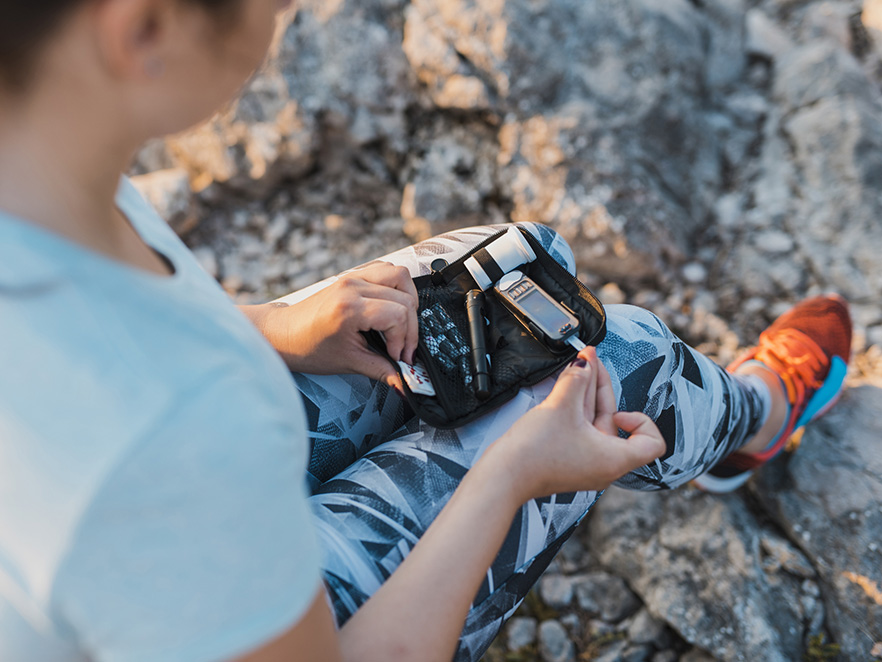
Remember that vans and RVs aren’t climate controlled, so internal temperatures will swing in and out of safe ranges for medication, especially in summer and winter. If the weather is extreme with intense heat or cold, it affects not only your insulin but your body’s response to it.
Unopened insulin that has been exposed to temperatures outside of the safe range of 36 to 46 degrees Fahrenheit can denature, meaning it loses its effectiveness without any visible sign that anything is wrong. Open insulin can be kept at room temperature for up to 30 days.
However, living in a van or RV rarely keeps you within that range. So your insulin could become denatured (aka “spoiled) and may no longer be working the way it should. This can quietly push you into dangerous territory before you realize what’s even going on.
A few investments in cooling devices make a big impact on your safety and wellbeing:
- A 12V cooler or fridge. These keep insulin (and food) at a set, stable temperature. Most full-timers consider this non-negotiable.
- A thermometer for your cooler. Every door open shifts the internal temperature. A thermometer tells you when you’ve drifted out of safe range before your insulin pays the price.
- A 12V air conditioner or heater. These keep your actual living space in temperature range, which makes your cooler’s job easier. Heaters plumb into your main fuel tank. Both run off your battery system.
Maintaining a power supply
When you live with type 1 diabetes, it’s important to have a reliable power supply for your cooling equipment and personal devices.
Without a charged battery system, you’d have no power for your CGM receiver or reader, no way to charge the phone your CGM app lives on, and nothing to power your 12v cooler to stay cold to keep your insulin temperature within safe range. This is a great example of why having plans A through C isn’t overcautious; it’s simply how full-time vanlife works best when you live with type 1 diabetes.
These days, there are plenty of ways to keep your power bank charged.
- Companies like EcoFlow have designed their Delta Pro models to be charged via 120v, solar, and EV car charging stations.
- Solar power is great as long as the sun is shining. But on overcast days or during the winter, the ability to draw in power is greatly diminished.
Navigating insurance, prescriptions and supplies
- Find out what your pharmacy options are. Before setting out or moving to a new location, be sure to research the pharmacy options in that area. Consider using a national chain like CVS or Walgreens so your information stays on file and you don’t have to set up a new account everywhere you go.
- Try a mail-order pharmacy. If you’re staying in one place long enough, a mail-order pharmacy can take the rest of the logistics off your plate. And if you need a mailbox, you can rent a personal mailbox through USPS, FedEx or UPS that gives you a stable mailing address. If you’re constantly moving, USPS general delivery lets you have mail held at almost any local branch. Just stop in and ask.
- Call your insurance company. One trick most nomads don’t learn until they need it: call your insurance company before you set out and ask for a “vacation override.” Most plans allow one to two early refills a year specifically for travelers, which keeps your supply ahead of your mileage.
- Pack extra supplies. It’s also wise to pack 2 to 3 times the supplies you think you’ll need, so you’re never short while waiting for a refill.
The bottom line
Vanlife for anyone takes time, planning, money and consideration. And living with type 1 diabetes includes a few more added steps and precautions.
But isn’t it always about the journey rather than the destination? Most people who live this lifestyle fulltime would argue that it’s more than worth it.
Constantly moving can make it hard to find community and connection. But you can roll out knowing that the Beyond Type 1 community is right beside you every mile of the way.

Author
Katie Gorman
Katie is a former paramedic turned health and wellness copywriter with over a decade of experience in emergency medicine. Her past career allowed her to train healthcare teams using high-fidelity medical simulation. Today, she focuses on improving health literacy through clear, accessible health communication to create a world where being healthy feels achievable to everyone. When she’s not writing, you can find her at the peak of a mountain, and most definitely snowboarding her way down in the winter months. Growing up in a landlocked state she developed a knack for surfing. She grooves to anything from the 70’s and loves... Read more
Related Resources

This article references in-kind partners supporting the Beyond Type Run team on race day. The...
Read more
Managing stress is an important part of caring for your overall well-being when living with...
Read more
If you would like to better support a friend or family member who is living...
Read more