Everything You Need in Your Daily T1D Care Kit
Written by: Julia Flaherty
10 minute read
April 30, 2026
When you’re first diagnosed with type 1 diabetes (T1D), one of the biggest questions that comes to mind is usually: What should I include in my daily care kit? A T1D diagnosis is a lot to take in. Having the right supplies to support you in everyday life is essential.
Whether you’re new to T1D or new to being proactive about it, this guide is designed to help you stay prepared for the good, the bad, the ugly and the unexpected. As you’ll soon learn, T1D comes with many unexpected moments (even for good self-managers).
This is about your day-to-day survival. Because when you’re prepared, you can feel like you’re in survival mode less and thriving mode more!
Diabetes supply bag, purse or case
The first thing you’ll probably want to purchase after a diagnosis is a T1D supply bag designed to hold all your diabetes supplies. You want to keep items like your blood glucose meter (BGM), continuous glucose monitor (CGM), insulin, pump supplies, syringes, alcohol swabs, emergency glucagon, lancing device, lancets and more safe.
A diabetes supply bag is the way to go! It’s important to pick a bag that’s easy to identify and has enough space to hold everything.
Here are some options worth considering:
- One2One Diabetes Upscale Travel Bags: These choices are useful for daily life, even though they are made mainly for travel. They can be used in many ways and are a good investment to keep your diabetes supplies safe.
- Sugar Medical Diabetes Cases: These are marketed as making daily diabetes management easier, and we have to agree. There are many sizes and patterns to choose from to fit your daily management needs.
- Etsy Diabetes Supply Bags: If you search “diabetes supply case” or “diabetes supply bag” on Etsy, you’ll find some fun and creative options to take care of your daily diabetes supplies.
- You can also find some generic options on Amazon.com or Walmart.com if you’re looking for a deal. Just search for “diabetes supply bag” or “diabetes supply case.”
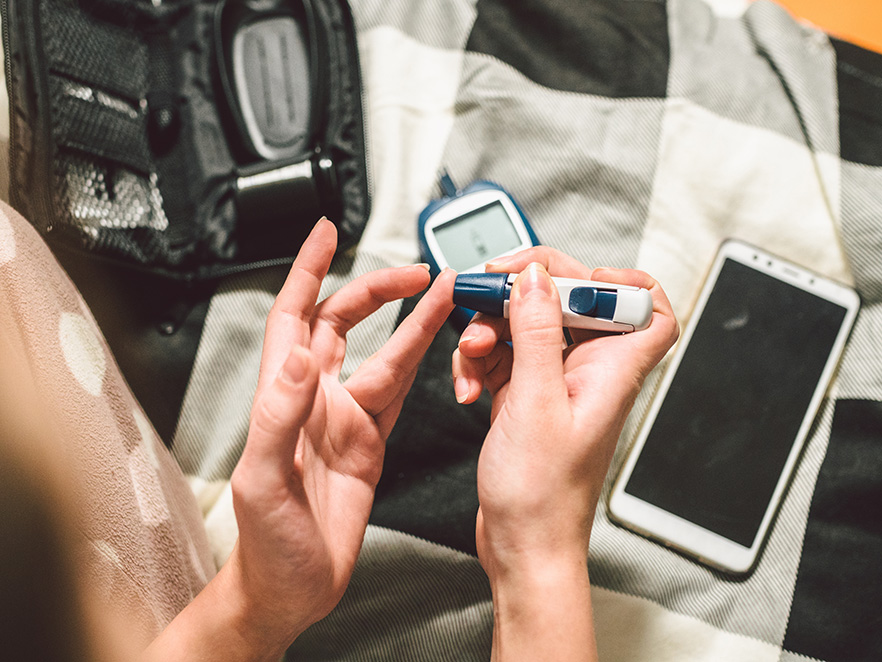
Blood glucose meter and test strips
Now it’s time to discuss what goes inside your diabetes supply bag.
Even if you have a CGM, you’ll still need a backup BGM. It can help you calibrate your CGM, support insulin dosing decisions and offer a more affordable way to check your blood sugar levels if a CGM becomes too pricey through your insurance.
Don’t forget to get some test strips for your BGM, too. You’ll need those to test. If your insurance requires a name-brand, ask your pharmacy for generic options. Sometimes, those can be run at a lower cost. They may not count toward your deductible, but they can save you money.
Sometimes, you don’t even have to get them with a prescription. Walmart and Walgreens, for example, usually offer off-the-shelf options if you’re in a bind.
Backup CGM
It’s a smart choice to keep a backup CGM on hand. This can be especially useful when you’re doing intense activities or dealing with extreme temperatures, which can make it more likely for the CGM to fall off.
Additionally, if your site change day is approaching, having a backup ready is always a wise move. Think about storing it in convenient places, like your work locker, car, backpack or purse so it’s easily accessible when you need it.
Being prepared helps you manage your health effectively.
Lancets and lancing device
To use your BGM properly, you’ll need some lancets and a lancing device. This pair helps you draw blood to check your blood sugar. You’ll need a blood droplet to use your test strips and BGM properly. Today, there are options for people who are afraid of needles, such as the Genteel lancing device.
Though lancets and lancing devices are usually things you can pick up generically through your pharmacy or off-the-shelf from the same retailers mentioned above, you may even be able to find them on Amazon! Talk to your healthcare team about your options if the name-brand your insurance prescribes is financially unmanageable.
Insulin vials and pens
Everyone with T1D and some people with type 2 diabetes (T2D) must use insulin.
If you use multiple daily injections (MDI) with traditional or smart pens, you should pack a three-day supply of both your short- and long-acting insulins at all times. It may sound like a lot, but the truth is, it’s probably just one of each pen (unless you’re almost towards the end of your vial). If you use an insulin pump, you should also pack a 3-day supply of compatible insulin cartridges.
When you’re not using your insulin, store it at 36 to 46 degrees Fahrenheit. Unrefrigerated insulin—the stuff you have on you during the day—should be kept between 59 and 86 degrees Fahrenheit. Once your insulin is removed from the fridge, in most cases it may be effective for up to 28 days.
Remember to rotate your supplies and check expiration dates. Look for signs of spoiling to determine whether your insulin is still usable or consult your healthcare provider if you’re truly unsure.
Signs of insulin spoilage inside your vial or pen may include:
- Clumpiness
- Cloudiness
- Fogginess
- Discoloration
- Crystalization
Insulin cooler (optional but helpful)
If you are worried about the integrity of your insulin’s temperature, investing in an insulin cooler or temperature-controlled device can be helpful.
Ice packs can be a little too extreme for keeping insulin cool, but they still work in a pinch. Ice packs are also usually not travel-friendly. If you’re flying, consult your airline to be sure what’s allowed on board.
Some current insulin cooling and temperature control options include:
- Frio insulin cooling case: good for keeping insulin cool in hot temperatures.
- TempraMed Vivi Cap: keeps your insulin safe from extreme temperatures.
- You can also find generic options at stores like Walmart or Walgreens, online or in-store. Amazon.com also has a variety. Just search for “insulin cooling case” or “insulin temperature control case” when shopping online to see what’s available. Read reviews to ensure you’re getting the best option for your investment.
Syringes or pen needles
Syringes and pen needles both deliver insulin. What you choose to carry with you usually depends on your insulin delivery method. If you use vials, syringes will serve you best. If you use pens, pen needles are best for you. And if you use an insulin pump, you’ll need a separate set of options altogether, which we’ll cover below!
Insulin pump supplies
Daily needs vary by pump. Consult your healthcare provider or your insulin pump company if you’re unsure what supplies you need to get by daily.
If you use an insulin pump, the supplies you may need day-to-day include:
- Infusion sets
- Reservoirs
- Rapid-acting (short-acting) insulin vials
- Backup insulin pen or syringes in case of pump failure (especially when traveling or far away from home)
- Backup pod(s) (if you use Omnipod)
- Batteries or pump charger (consult your pump company for specific requirements)
Glucose and emergency glucagon
Anyone who uses insulin or another blood-sugar-lowering medication should have emergency glucagon and glucose available at all times. Even if you’ve never had to use emergency glucagon, it’s best practice to keep it on or near you day to day.
Glucose (sugar) can be used to treat low blood sugar levels that aren’t an emergency. Some of the best options include:
- Glucose tablets, powders, gummies or gels
- 4 oz Juice boxes
If you are unconscious or unable to consume liquids or edible forms of glucose, emergency glucagon should be used, or someone should administer it to you. While there was only one emergency glucagon for decades—and it was complicated to use—there are many new and improved products available today, including:
- Nasal glucagon—Baqsimi®: This is an emergency glucagon that’s administered through your nose.
- Glucagon pen—Gvoke HypoPen®: This is a premixed glucagon injection that you press against your thigh. The auto-inject device makes it quick and easy to use. It is also available in a prefilled syringe (PFS).
- Glucagon Prefilled Syringe—Gvoke Kit®: This is a premixed glucagon vial with a syringe, allowing you to draw up the dose manually and inject it directly into your thigh.
- Glucagon pen—Zegalogue®: Also a premixed glucagon, available as an easy-to-use auto-inject device. It is also available in a prefilled syringe (PFS).
Ketone testing products
If you thought that urine test strips were the only way to test your ketones at home, think again! Ketone monitoring has gotten better over the years. Now, there are many ways to test, including urine test strips, breathalyzers, and blood meters (similar to your regular BGM).
Monitoring ketones is important, especially on sick days or if you’ve had chronic high blood sugar with no relief. Ketones can be a sign your body is going into diabetic ketoacidosis, which can happen even after you’ve been diagnosed.
These are especially important to have on hand when traveling since you’ll be outside of your routine and unexpected changes can lead to irregular blood sugar levels.
Medical identification and details
If you have T1D, consider getting a medical ID tag, necklace or bracelet. This way, if there’s an emergency, people can quickly see that you have T1D. Tattoos aren’t the best choice for this because emergency responders might not know that a tattoo means you have diabetes. Some laws even make it hard for them to assume a tattoo is a medical condition.
Besides wearing an ID, it’s also smart to keep your medical information with you, like in your wallet or on your phone. Make sure to check your phone settings and add important health details that emergency responders could use in an emergency.
Other helpful diabetes extras
The following items aren’t exactly necessary to carry around, but can be helpful for peace of mind or for the hyper-organized diabetes manager. Consider having the following available day to day, if not on you, at least at home:
- Alcohol swabs: This is a non-negotiable. We know it might be annoying, but you need to clean your skin before and after using a syringe or lancet. Doing this is all about keeping you safe and healthy. If you keep your body clean, you help protect your health!
- Bandages or medical tape: This can be helpful to have on hand in case you need to dress minor wounds or secure your devices.
- Sharps container: It’s unlikely that you’ll find a sharps container while out and about, though some gas stations offer them in their restrooms. Try repurposing an old pill bottle and putting it in your bag, backpack or purse as an on-the-go sharps container that you can dump into your big one at home later.
Only you get to decide what’s in your daily diabetes care kit
Dealing with diabetes every day is a lot. We get it.
It might seem overwhelming at first, but little by little, you’ll figure out what you need to bring with you and what you can leave at home. Some people with diabetes (PWD) like to carry more supplies, and that’s completely fine! Everyone has their own way of managing their care.
The most important thing is that you feel confident and supported in the choices you make. Your needs may change as life changes, too. Along the way, always remember that you’re not alone and you’ve got this!
Diabetes is demanding, but you’re allowed to figure this out one choice, one thing and one moment at a time.
Are you newly diagnosed with T1D? Do you need help figuring it all out? Download Beyond Type 1’s Beyond Diagnosis Beginner’s Guide to Type 1 Diabetes here.



Author
Julia Flaherty
Julia Flaherty has lived with type 1 diabetes since 2004. She is passionate about empowering others navigating chronic illness and promoting healing through creativity. Julia is a content marketing specialist, writer, and editor with health and wellness coaching certification. She is also the founder of Chronically You, which provides wellness coaching and marketing services. Julia has created hundreds of blogs, articles, eBooks, social media campaigns, and white papers since starting her career in 2015. She is also the author and illustrator of "Rosie Becomes a Warrior," a children's book series in English and Spanish that empowers children with T1D. Julia... Read more
Related Resources
If you would like to better support a friend or family member who is living...
Read more

Topic sensitivity warning: This guide mentions suicide and mental health challenges. Please read it at...
Read more

If you are the parent of a young child with type 1 diabetes (T1D), you...
Read more