From Urine Strips To Continuous Monitoring: The Evolution Of Ketone Testing
Written by: Christine Fallabel
5 minute read
July 23, 2026
For people living with diabetes and require insulin, ketones have always occupied a strange place in diabetes management. While not usually monitored daily, we know that they’re important.
Monitoring for ketones can prove lifesaving when illness strikes, insulin delivery gets interrupted, or when we’re stubbornly high for reasons unknown.
Why does ketone testing matter for people with diabetes?
Monitoring for ketones is crucial because they are often the earliest sign that the body isn’t getting enough insulin. When this happens, the body begins breaking down fat for energy, producing ketones that accumulate in the bloodstream. If left untreated, this process can develop into diabetic ketoacidosis (DKA), a potentially life-threatening complication. Yet somehow, ketone monitoring has remained largely unchanged for decades—until recently.
Glucose monitoring, on the other hand, has undergone remarkable transformations over the past few decades: from urine testing to manual finger pricks and glucometers with two-minute countdown times to continuous glucose monitoring (CGM) with some devices providing readings every minute. By comparison, ketone testing has lagged far behind and for the longest time, remained manual and reactive. Many people monitor for ketones only after symptoms of stubborn high blood sugar have already set in: thirst, frequent urination, lethargy and higher-than-normal blood glucose despite correction boluses.
The mental checklist usually follows in this order: Am I getting enough insulin? Am I feeling sick? Should I test for ketones? Do I have ketone strips? And most importantly: are they expired?
How has ketone testing evolved over the past 150 years?
Ketone testing has come a long way since it was first studied in the 1800s. Here’s a look at the key milestones that got us from lab-based urine analysis to today’s continuous monitoring.
1848: Ketones are first identified
Ketones were first identified in human urine by chemists studying diabetic metabolism.
Early 1900s: Laboratory testing begins
Early laboratory tests for urinary ketones were developed.
1940s: At-home testing becomes commercially available
The first commercially available urine ketone tests hit the market.
1960s–70s: Ketone dipsticks go mainstream
At-home ketone urine dipsticks (Ketostix) became popular.
1980s: Ketone testing becomes standard of care
Ketone testing didn’t become a standard of care for diabetes during illness and prolonged high blood glucose until this decade.
2000: Blood ketone meters replace urine strips
The first at-home blood ketone meters were FDA-approved, offering more precise and portable testing than urine strips.
Present day: Continuous ketone monitoring arrives
Abbott received CE Mark in Europe for the world’s first continuous ketone monitor (CKM), which tracks both blood glucose and ketones simultaneously and consistently. This approval marks a regulatory milestone and is an indication that FDA approval of the device may soon be coming to the US.
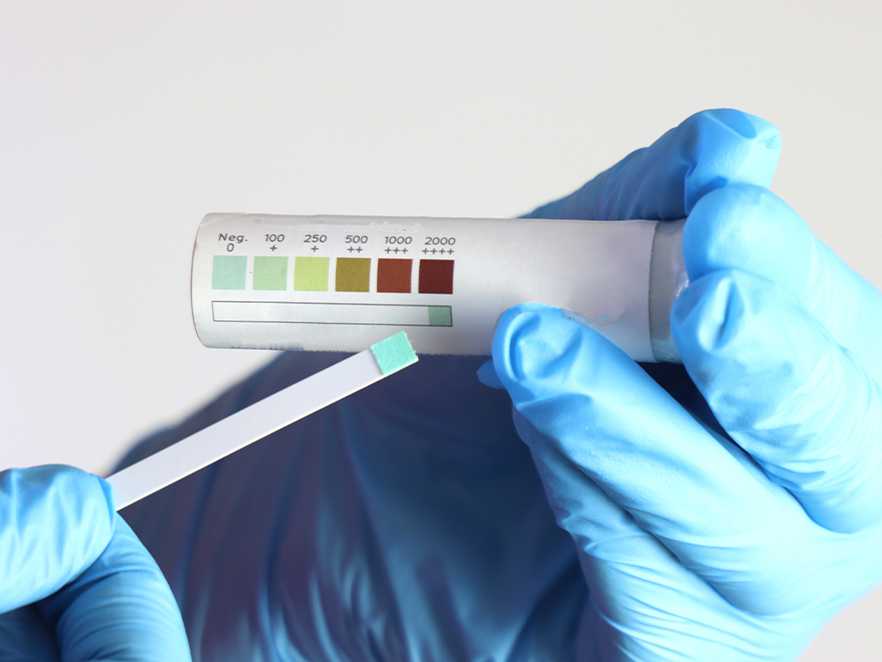
When should you test for ketones?
Current recommendations encourage ketone testing when you’re feeling sick, if you have an infection, if you’re experiencing stubborn high blood glucose levels of 250 mg/dL or higher for several hours, when you may be dehydrated or when you’re taking certain medications (like starting steroids). If you take a sodium-glucose cotransporter 2 (SGLT-2), you may have a higher risk for ketones especially if you have type 1 diabetes. If you are at high risk for DKA, you may want to start testing for ketones at 200 mg/dL.
Unlike your blood sugar level, which you can feel the highs and lows of easily, most people living with diabetes don’t think about ketones on a daily basis. But it’s important to think about ketones when having them can be the most dangerous:
- When you’re sick
- Facing an insulin pump blockage (aka cannula occlusion)
- Have an unexplained high blood sugar level
What is continuous ketone monitoring (CKM)?
Continuous ketone monitoring is an entirely new way of thinking about diabetes safety. Rather than asking people to remember to manually and reactively test for ketones, continuous monitoring has the potential to identify rising ketone levels automatically.
This can provide earlier awareness if you’re having insulin delivery problems or feeling sick. Rather than reacting to ketone levels, CKM technology can help solve problems before they become emergencies, possibly even preventing DKA.
How could CKM integrate with diabetes technology in the future?
Integration of CKM within current diabetes technology will be key. The greatest promise of CKM is where glucose trends, insulin delivery data and ketone levels can work together to provide users with earlier warning signs of infusion set failures, expired insulin or DKA.
Future automated insulin delivery (AID) systems could also use data to increase insulin delivery during illness or infection, preventing hospitalizations and improving the lives of millions of people along the way.
Continuous ketone monitoring is another step in the innovation journey to make diabetes management more seamless and integrated into everyday life.
For far too long, ketone testing has remained an afterthought: something tucked away in a corner until high blood glucose levels forced testing into focus. But the future of continuous ketone monitoring can offer a different possibility, one where ketone levels are consistent and readily available, reducing uncertainty in care and helping people respond to their body’s needs before a crisis develops.
Are you or someone you love in need of a diabetes management refresher? Download our Beginner’s Guide to Thriving with Type 1 Diabetes! Available in English and Spanish.



Author
Christine Fallabel
Related Resources

When you hear the words “diabetes research,” you might picture a scientist in a white...
Read more

Disclaimer: Beyond Type 1 does not encourage or condone illegal activity, including underage drinking or...
Read more

Being a teacher means caring for 20 to 30 kids every day. (You deserve a...
Read more