Can Your Wearables Predict Tomorrow’s Glucoses?
Written by: Julia Flaherty
6 minute read
August 4, 2026
Every person living with type 1 diabetes (T1D) has experienced it—after a poor night’s sleep, glucoses suddenly seem harder to manage. Sometimes it feels like bad luck. Other times, it feels impossible to know whether diabetes caused the rough night or whether the rough night caused the difficult diabetes day that followed.
For one person living with T1D, that question became a year-long research project.
Using wearable data to detect and predict diabetes patterns
Using 365 days of Dexcom continuous glucose monitor (CGM) data alongside information collected from his smart ring, Josh Webb analyzed how recovery metrics, sleep, activity and glucose levels interacted over time.
His goal was simple—Josh wanted to determine whether wearable data could help predict changes in glucose before they happened.
“I got pretty obsessed with the data management of diabetes,” he said. “That’s how I’ve always managed it from the moment I got it.”
Josh’s interest goes beyond lived experience. After being diagnosed with T1D 24 years ago, he earned a PhD in bioengineering and developed a passion for analyzing data.
That background made him curious about whether the information already being collected by wearable devices could reveal patterns that were easy to miss in day-to-day life.
“I started to see a correlation between the data from my smart ring that I’m obsessed with and some of my glucose values,” he said. “Without that data, we’d have no idea. We’re just going off of feel.”
Going beyond standard health metrics
The project required exporting a year’s worth of data from both devices before comparing dozens of variables. Artificial intelligence (AI) helped organize the information, but the analysis still required clinical judgment.
“Claude was really helpful at sifting through the data and saying, ‘Here’s potentially something,'” Josh explained. “Then I put my diabetes hat on to say, ‘This is something of value. This isn’t.'”
One of the first surprises came almost immediately.
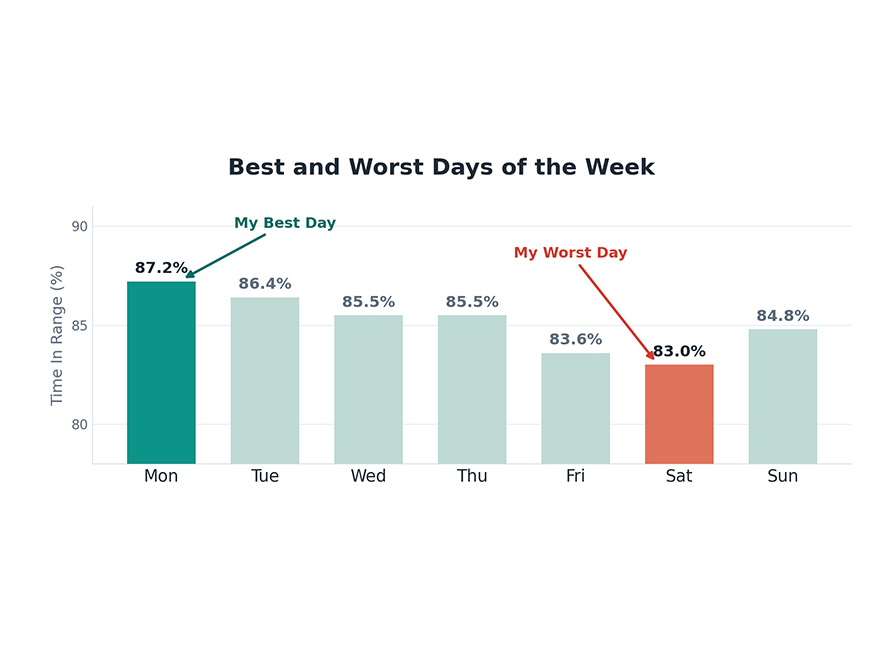
He expected broad scores, such as overall sleep or readiness, to have the strongest relationship with glucose management. Instead, the more meaningful connections appeared in the individual measurements that contributed to those scores.
“I would’ve bet a million dollars I would’ve found a correlation to one of those big numbers,” he said. “It wasn’t until I took a step back and looked at the underlying metrics that I started to see what I expected.”
Recovery stood out above everything else.
“What really correlated nicely to the next day’s glucose glucose values wasn’t how long I slept or what time I woke up,” he said. “It was the actual recovery I was getting while I was sleeping.”
Recovery didn’t end when Josh woke up
One example came after spending several hours golfing outdoors in the summer heat.
“My body’s still trying to recover,” he explained. “When I woke up and saw those recovery metrics, I thought, ‘This would be a day where I’m going to have poorer glucose values.'”
Instead of waiting for his glucose levels to rise, Josh began thinking about whether those recovery metrics could help him prepare in advance. That became one of the biggest takeaways from the project.
“I can take some preemptive action rather than reactively manage it,” he said.
The relationship did not stop there.
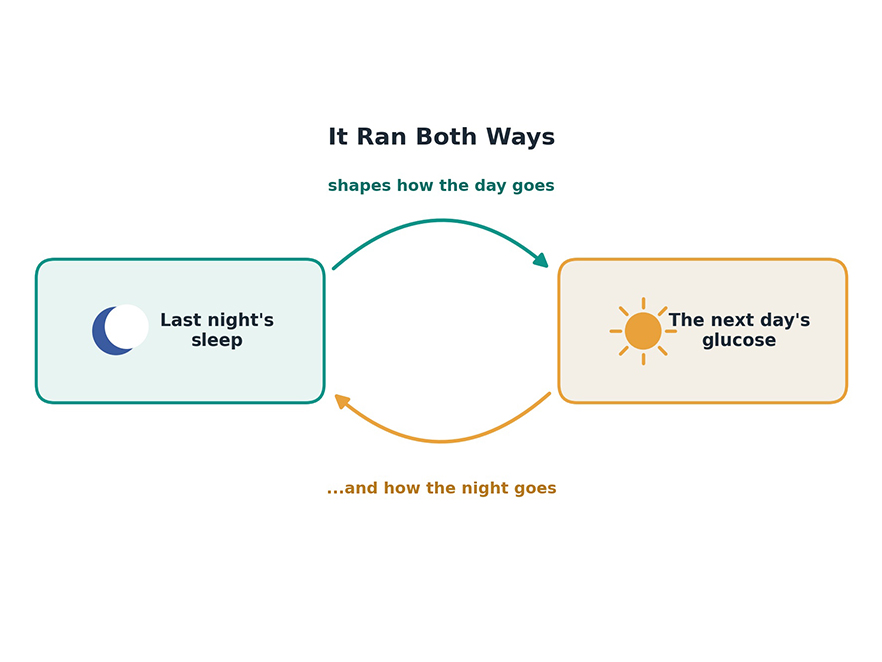
“What really surprised me was that if I had a day of bad glucose, my sleep that night would suffer as well.”
Rather than finding a single direction of influence, his data suggested an ongoing cycle.
“If I have bad sleep, I have bad glucoses. If I have bad glucoses, I have bad sleep, and the cycle continues,” Josh explained.
For many people living with T1D, that experience feels familiar. His analysis provided data supporting what many have observed for years. It’s a constant feedback loop.
Personal patterns aren’t universal rules for people with T1D
As the project progressed, Josh began making small changes to his insulin therapy. His nights of poor recovery motivated him to take action. Josh reminds his fellow T1D community members that his choices were based only on his personal data and shouldn’t be seen as treatment advice.
“I’m no diabetes educator. I’m no endocrinologist,” he said. “This is just for me.”
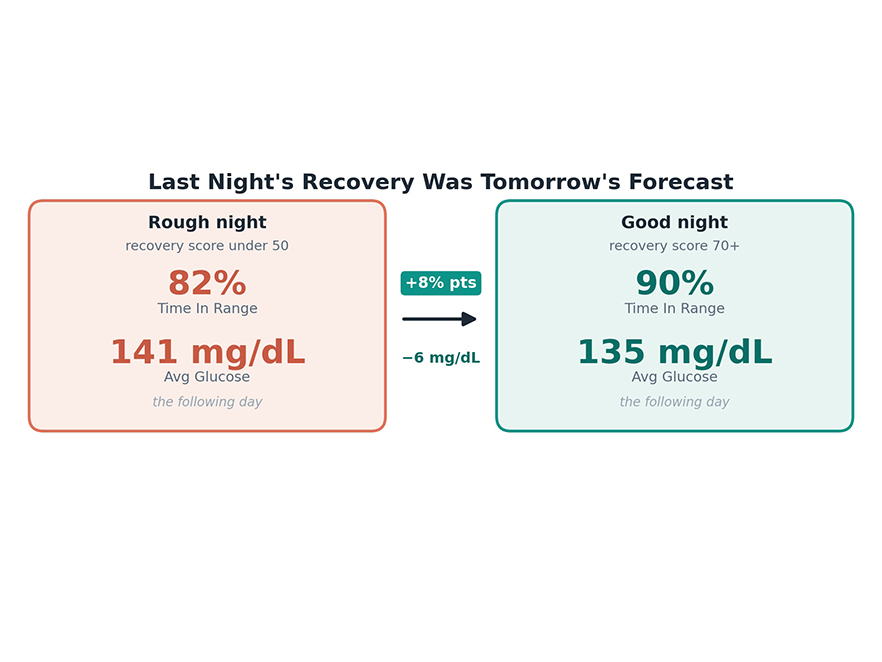
Because Josh identified consistent relationships between certain recovery metrics and the average increase in glucose the following day, he found he could estimate how much additional basal insulin he might need.
“Now it’s not just bad sleep equals bad glucose,” he said. “It’s this amount of bad sleep equals this amount of bad glucose.”
He also credits his automated insulin delivery (AID) system with providing an important safety net if his estimates are too aggressive.
How did exercise impact Josh’s diabetes data?
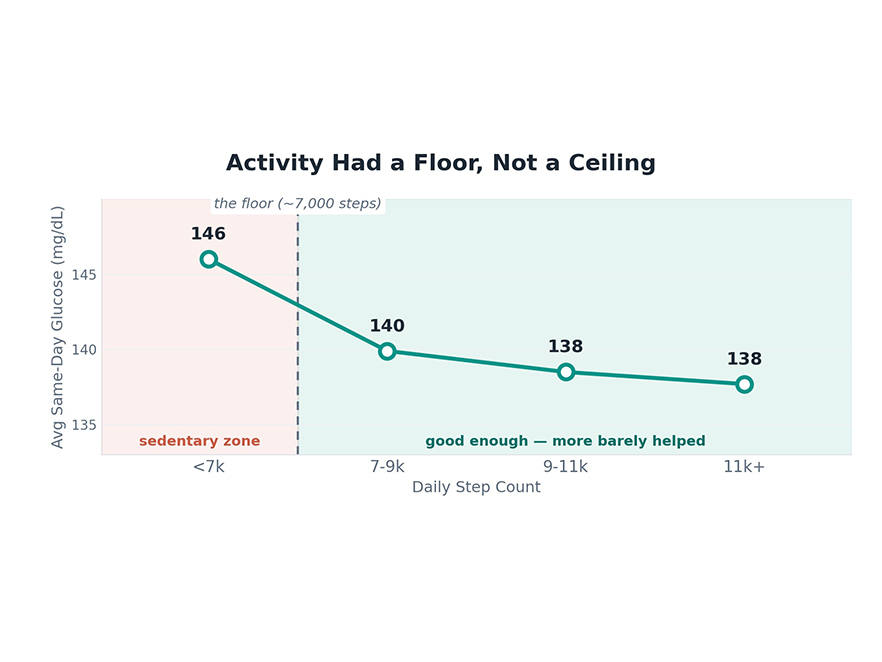
One finding challenged his expectations—Josh assumed that more daily steps would consistently translate into better glucose management.
Instead, the biggest difference appeared between days spent moving and days spent mostly sitting.
“What surprised me was that I didn’t find a great relationship with more activity and lower glucose,” he said.
Once he consistently reached roughly 7,000 daily steps, additional movement appeared to provide little extra benefit.
“I would’ve thought 8,000 would be better than 7,000. I didn’t really see that.”
He laughed and pointed out a factor that might have complicated the analysis.
“If my glucose’s high, I’m kind of a rage walker,” Josh admitted.
Those long walks often happened because he was already managing a stubborn high glucose, making the relationship between exercise and glucose harder to untangle.
What’s next for Josh’s T1D data experiment?
Although the project focused on one person’s experience, Josh believes it points toward where diabetes technology is headed.
“I think within our lifetime this will be automated,” he said. “We won’t have to go digging for these correlations.”
Instead, Josh imagines future diabetes technology that combines data from multiple wearable devices to provide individualized guidance before glucose levels begin to drift.
Until then, he encourages fellow T1D community members to prioritize curiosity over perfection.
“I wouldn’t suggest people do this because they think it’s going to completely change their diabetes management,” he said. “I’d do it just to familiarize yourself with what’s going on.”
After spending a year immersed in his own data and sharing his experience on Reddit, the biggest lesson was surprisingly simple.
“I hope people know that what they’re feeling is real,” he said. “Sometimes you’re like, ‘I cannot catch a break.’ There’s something behind it. It’s not in your head.”
For people living with T1D, that may be the most meaningful finding of all. Even when glucose levels feel unpredictable, there may be measurable patterns beneath the surface. Understanding those patterns will not eliminate diabetes or the effort it requires, but it may eventually help people respond with greater confidence rather than more guesswork.
Be a part of a community that understands what it’s like to live with T1D. Join our Community Apps! Make connections that matter.


Author
Julia Flaherty
Julia Flaherty has lived with type 1 diabetes since 2004. She is passionate about empowering others navigating chronic illness and promoting healing through creativity. Julia is a content marketing specialist, writer, and editor with health and wellness coaching certification. She is also the founder of Chronically You, which provides wellness coaching and marketing services. Julia has created hundreds of blogs, articles, eBooks, social media campaigns, and white papers since starting her career in 2015. She is also the author and illustrator of "Rosie Becomes a Warrior," a children's book series in English and Spanish that empowers children with T1D. Julia... Read more
Related Resources

If you are the parent of a young child with type 1 diabetes (T1D), you...
Read more

If you stumbled on this guide, odds are you’re dating someone with type 1 diabetes...
Read more

Sensitive Topic Warning: This article discusses anxiety, stress, depression and mood swings, which may be...
Read more